Coordination & communication
- 6Asynchronous Programming
- 7Multi-Threading
- 8Message Passing
- 9Failure and Recovery
A sequential program and a slow device
Java// k numbers the portions; the bound of portion k is 250000 + 83333 * (k % 3)
for (int k = 1; k <= 8; k++) {
    // a computation: how many primes are there below the bound of portion k?
    String portion = produceNextPortion(k);
    // a slow device: prints the answer as one line of the page
    processPortionTaken(portion);
}
Dijkstra’s bounded buffer (1965)
E. W. Dijkstra, Cooperating sequential processes, EWD 123, 1965: section 4.3, page 39 of the manuscript. Beside it, the same lines transcribed.
"begin integer number of queuing portions, number of empty positions,
              buffer manipulation;
      number of queuing portions:= 0;
      number of empty positions:= N;
      buffer manipulation:= 1;
      parbegin
      producer: begin
        again 1: produce next portion;
                 P(number of empty positions);
                 P(buffer manipulation);
                 add portion to buffer;
                 V(buffer manipulation);
                 V(number of queuing portions); goto again 1 end;
      consumer: begin
        again 2: P(number of queuing portions);
                 P(buffer manipulation);
                 take portion from buffer;
                 V(buffer manipulation);
                 V(number of empty positions);
                 process portion taken; goto again 2 end
      parend
end" .
EWD 123, 1965, section 4.3. His P is acquire, his V is release.
Two differences from Dijkstra’s program:
- his processes run for ever; ours stop after eight portions;
- his buffer has room for N portions; ours for two.
Each loop is an ordinary sequential program.
Four of its lines are the actions we know from the previous slide: produce a portion, put it in the queue, take one out, process it.
These lines call acquire.
Intuitively, acquire waits until something is available, then claims it:
- the producer, a free place;
- the consumer, a portion;
- each, the right to change the queue.
These lines call release.
Intuitively, release makes something available, and a process waiting for it can go on:
- the producer, a portion;
- the consumer, a free place;
- each, the right to change the queue.
Each of those three objects is a semaphore*: a counter, with two operations:
acquirewaits until the counter is above zero, then takes one off;releaseadds one.
We come back to them shortly, for what each one allows, but also helps to prevent.
*how a semaphore is built, and what a language offers in its place will be covered in Session 7.
What will be true in every run?
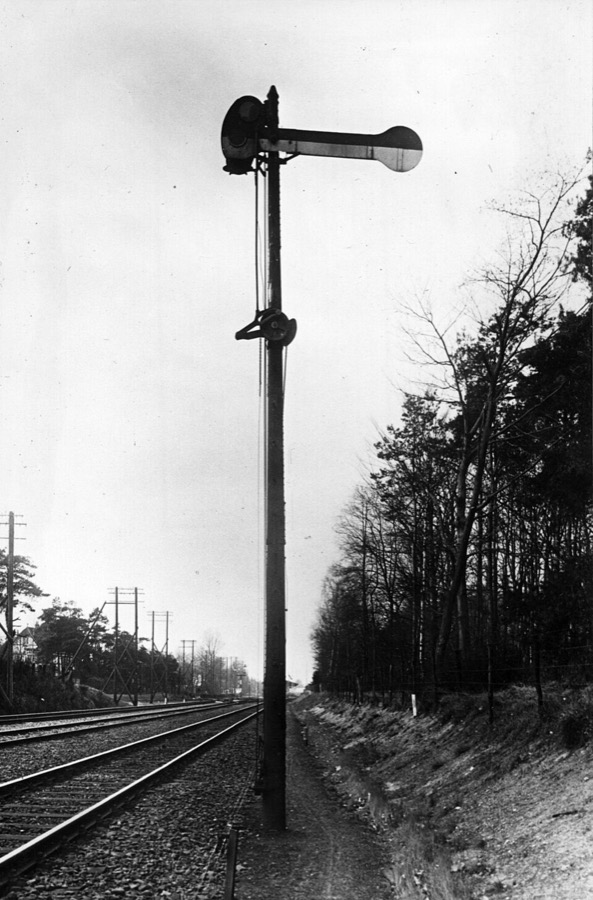
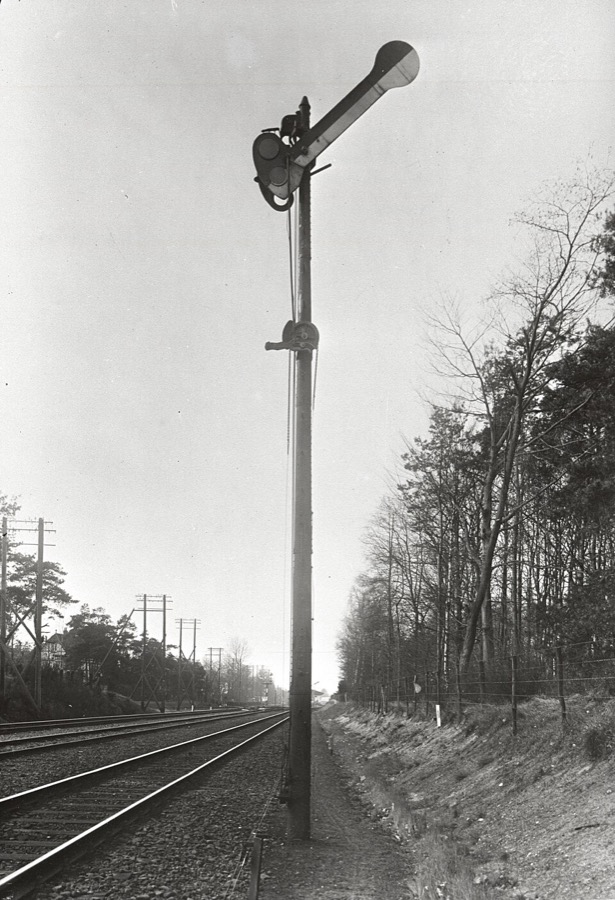
Before programming, a semaphore was a railway signal: an arm on a post, guarding a stretch of track.
P: a train passes the signal only when it shows safe; behind it, the signal is set to stop.
V: the train has left the stretch; the signal is set to safe again.
One train at a time on the stretch.
One signal near Bilthoven, 1938 (Het Utrechts Archief, public domain). The railway is Dijkstra’s own picture, for a semaphore that is 0 or 1: EWD 51.
Java// producer
for (int k = 1; k <= 8; k++) {
    String portion = produceNextPortion(k);
    numberOfEmptyPositions.acquire();     // wait for room
    bufferManipulation.acquire();         // one at a time on the queue
    buffer.addLast(portion);
    bufferManipulation.release();
    numberOfQueuingPortions.release();
}
// consumer
for (int k = 1; k <= 8; k++) {
    numberOfQueuingPortions.acquire();    // wait for a portion
    bufferManipulation.acquire();         // one at a time on the queue
    String portion = buffer.removeFirst();
    bufferManipulation.release();
    numberOfEmptyPositions.release();
    processPortionTaken(portion);
}
What the runs show
- Every run prints portions 1 to 8 in order, each after it is produced.
- The order of turns differs from run to run. The program and its input are the same; only the device’s times differ, and the order follows them.
- The columns record only produced and processed. Up to four portions can be produced and not yet printed: one at the device, two in the queue, one in the producer’s hands, waiting for room.
A short history of concurrent and distributed programming
Coordination and Communication
Coordination and communication
Coordination: when a process may act depends on what the others have done or are doing.
not before
P waits until Q has acted
not at the same time
P and Q are never both inside
Communication: data passes from one process to another.
through memory that both can reach
P writes, Q reads
by a message
P sends, Q receives
Coordination and communication in the bounded buffer
Java// producer
for (int k = 1; k <= 8; k++) {
    String portion = produceNextPortion(k);
    numberOfEmptyPositions.acquire();
    bufferManipulation.acquire();
    buffer.addLast(portion);
    bufferManipulation.release();
    numberOfQueuingPortions.release();
}
// consumer
for (int k = 1; k <= 8; k++) {
    numberOfQueuingPortions.acquire();
    bufferManipulation.acquire();
    String portion = buffer.removeFirst();
    bufferManipulation.release();
    numberOfEmptyPositions.release();
    processPortionTaken(portion);
}
- not before: the consumer takes no portion before one is produced.
numberOfQueuingPortionscounts the portions in the queue:acquirewaits while it is 0, the producer'sreleaseadds one. - not before: the producer adds no portion before there is room.
numberOfEmptyPositionscounts the empty places:acquirewaits while it is 0, the consumer'sreleaseadds one. - not at the same time: the two never change the queue at once.
bufferManipulationis taken before the queue is touched and given back after. - communication: a portion passes through the queue, memory that both reach.
addLastin the producer,removeFirstin the consumer.
Correctness: safety and liveness
“Software is hard.”
Donald Knuth
Writing a correct sequential program is already a challenge. For a concurrent or distributed program it is an order of magnitude harder: one input has many executions, and a part can fail while the others go on.
In general, the correctness of a program splits into properties of two kinds.
Safety
Nothing bad ever happens.
A violation happens at one definite moment.
Liveness
Something good eventually happens.
No finite beginning of an execution violates it.
Common correctness properties
| property | what it says | an example | |
|---|---|---|---|
| mutual exclusion | two processes are never in the same critical section at the same time | the bounded buffer: one at a time on the queue | safety |
| linearizability | the calls answer as if made one at a time, in an order that keeps a call that returned before one that was made later | a bank account that many clients use at once | safety |
| deadlock freedom | no state is ever reached in which each process waits for something that only another can give | two transfers, each holding one lock and waiting for the other’s | safety |
| starvation freedom | every process that asks is served in the end | every request to a server gets an answer | liveness |
| eventual consistency | if the requests stop, the copies agree in the end | two copies of an account on two machines | liveness |
Language support for correctness
For every property, who makes it hold: the language, a library, or the programmer?
| the language (compiler, runtime) | a library | the programmer (keywords, discipline) | |
|---|---|---|---|
| mutual exclusion safety | Rust: no way to the data in a Mutex<T> without its lock. Erlang: nothing is shared. | locks and semaphores: java.util.concurrent | synchronized, sync.Mutex: every access must lock; nothing checks |
| starvation freedom liveness | Go, Erlang interrupt a long computation; JavaScript does not | fair locks: new ReentrantLock(true) | no long computation on the loop; time limits |
This is not a course on concurrency or on distributed systems: it meets their notions through the programming language.
| mutual exclusion | which construct holds the lock, and who checks that it is taken? |
| failures | in what form does a failure reach the program? |
Overview of Part 2
The questions of Part 2
| 6 | At which points of a function's text can control pass to another process, and what represents the suspended computation? |
| 7 | When two processes can reach the same data, which constructs express mutual exclusion and condition synchronization, and do they compose? |
| 8 | If processes share no data, what does passing a value from one to the other mean: is it shared, copied, or moved? |
| 9 | When a fault occurs, in what form does it reach the program, which constructs report it and recover from it, and what remains for the programmer? |
A running example: a bank account
deposit(n) answers ok
withdraw(n) answers ok or refused
as if one at a time, in some order
Linearizability: in every execution, the calls can be arranged in one sequence in which each call answers as it would if the calls were made alone, in that order, and a call that returned before another was made comes first.
Serving many clients: one loop, or a thread each
Ten thousand clients: a thread for each, or one loop for all?
Ten thousand clients at once, most of them idle: the C10K problem (Kegel, 1999).
Message passing: isolated parts with mailboxessession 8
Replication: two copies and a failed linksession 9
Two copies cannot reach each other: what does a copy answer to a client? Refuse to answer, or let them differ?
Part 2 at a glance
What does a program do while it waits, and where is the rest of a function while it waits?
Appendix
The bounded buffer in asynchronous style
Every run prints portions 1 to 8 in order, each after it is produced.
Java// one at a time on the queue: one thread runs all of this
static final ScheduledExecutorService loop =
    Executors.newSingleThreadScheduledExecutor();
// producer
static CompletableFuture<Void> produce(int k) {
    if (k > 8) return done();
    String portion = produceNextPortion(k);
    return queue.put(portion)           // wait for room
        .thenComposeAsync(v -> produce(k + 1), loop);
}
// consumer
static CompletableFuture<Void> consume(int k) {
    if (k > 8) return done();
    return queue.take()                 // wait for a portion
        .thenComposeAsync(p -> processPortionTaken(p), loop)
        .thenComposeAsync(v -> consume(k + 1), loop);
}
The animation of the bounded buffer
The diagram of slide 3 is a program: two async functions sharing one array as the queue.
until waits and signal wakes, in the parts of acquire and release.
The device’s time is random: every run differs.
One thread: the turn passes only at an await, so one at a time on the queue needs no semaphore. Session 6.
JavaScript// producer
for (let k = 1; k <= 8; k++) {
  await sleep(PRODUCE[(k - 1) % 3]);  // produce next portion
  const c = chip(k);
  while (queue.length === 2)          // wait for room
    await until('room', producer);
  queue.push(c); place();             // add portion to buffer
  signal('portion');
}
// consumer
for (let k = 1; k <= 8; k++) {
  while (queue.length === 0)          // wait for a portion
    await until('portion', consumer);
  const c = queue.shift(); place();   // take portion from buffer
  signal('room');
  moveTo(c, AT_CONSUMER);
  await sleep(0.8 + Math.random() * 0.9);  // the device
  print(c, k);                        // process portion taken
}
Example: the requirements of a bank account
Liveness: the request gets its answer in the end; the copies agree in the end.
Safety: the three requirements at the balance. Each says never.
Language support, property by property
| the language (compiler, runtime) | a library | the programmer (keywords, discipline) | |
|---|---|---|---|
| mutual exclusion | Rust: no way to the data in a Mutex<T> without its lock. Erlang: nothing is shared. | locks and semaphores: java.util.concurrent | synchronized, sync.Mutex: every access must lock; nothing checks |
| linearizability | Erlang: a process handles one message at a time | AtomicInteger: each operation, alone | two such operations in a row are not one: check, then act |
| deadlock freedom | Prevented by none of Java, Rust, Go, Erlang. Go’s runtime detects a total deadlock. | tryLock with a time limit | one order in which all code takes its locks |
| starvation freedom | Go, Erlang interrupt a long computation; JavaScript does not | fair locks: new ReentrantLock(true) | no long computation on the loop; time limits |
| eventual consistency | Provided by no general-purpose language. | mergeable data types, such as a set with union | which merge is right; when to send again |
Session 6: Asynchronous Programmingconcurrency on one thread
- One thread runs all our code. A function that waits gives the thread back.
- We look at what a language does at an
await.
After this session we can explain:
- where the rest of a function is kept while it waits;
- why waiting is not running, and why one thread does not rule out a race.
Languages: JavaScript; Python beside it.
Session 7: Multi-Threadingshared-memory concurrency: locks, atomic operations, ownership
- Several threads run our code at the same time, on the same memory.
- We look at how shared data is protected, who checks that it is, and when nothing needs protecting.
After this session we can explain:
- why a lock protects only if every access takes it, and how a compiler can check that;
- why two protected operations, one after the other, are not one protected operation;
- why a parallel
mapof a function without effects gives the same result in every execution.
Languages: Java; Rust and OCaml beside it.
Session 8: Message Passingconcurrency without shared memory: channels and actors
- Processes share no data. They send each other messages, and every message sent arrives.
- We look at what is addressed (a channel, or a process), and at what sending does to a value.
After this session we can explain:
- why a process that handles one message at a time needs no lock on its own state;
- what happens to a value that is sent: shared, copied, or handed over;
- why messages remove neither the deadlock nor the lost deposit.
Languages: Go; Erlang.
Goportions := make(chan string, 2)
go func() {
    for k := 1; k <= 8; k++ {
        portions <- produce(k)
    }
    close(portions)
}()
for p := range portions {
    process(p)
}Erlangloop(Balance) ->
receive
{deposit, N, From} ->
From ! ok, loop(Balance + N);
{withdraw, N, From} when N =< Balance ->
From ! ok, loop(Balance - N);
{withdraw, _, From} ->
From ! refused, loop(Balance)
end.Session 9: Failure and Recoverydistributed programming: delivery not assumed
- A message can be lost, a process or a machine can stop, and the rest goes on.
- We look at the form in which a failure reaches a program, and at what the program can do then.
After this session we can explain:
- why a process that is slow and a process that has stopped look the same from outside;
- when a request may be sent again;
- what a restart gives back, and what it does not.
Languages: Erlang; OCaml.