Static type systems
Mars Climate Orbiter, 1999
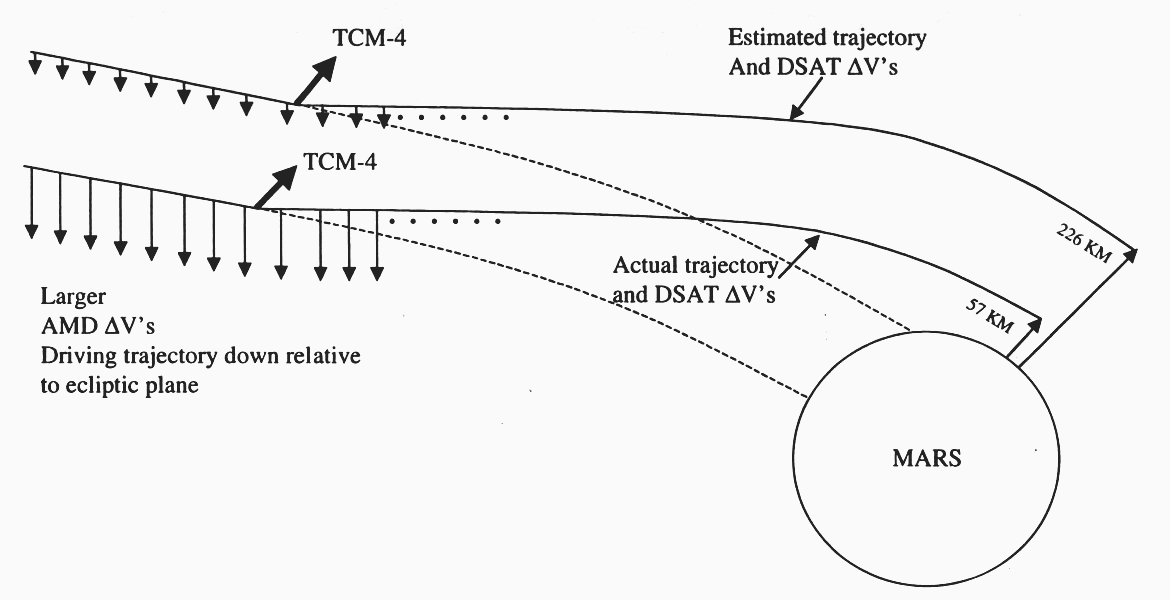
Lockheed Martin's program writes impulses in pound-force seconds
JPL's program reads them as newton-seconds
a factor 4.45: 57 km above Mars instead of 226 km, and the spacecraft is lost
what would have caught it?
one type for each unit: the mix becomes a type error, reported before the run
type checking
an operation applied to a value of the wrong type:
"5" + 37do we get
- a compile-time error? (OCaml, Rust, Go)
- a runtime error? (Python, Julia)
- the number 42? (PHP; Visual Basic with Option Strict Off)
- the string
"537"? (Java, Scala, Kotlin) - an out-of-bounds pointer? (C, C++)
- something else?
 +

and what does this one give?
37 / "5"types, intuitively
a type names a collection of values, together with the operations defined on them
| type | values | operations |
|---|---|---|
int | \(\dots, -1, 0, 1, 2, \dots\) | \(+\), \(\times\), \(<\) |
bool | true, false | conditional, negation |
string | "", "a", "ab", \(\dots\) | concatenation, length |
| \(\mathtt{int} \rightarrow \mathtt{bool}\) | the functions from integers to Booleans | application |
a type error is an operation applied to a value on which it is not defined:
length(42)1 + length42("abc")
types: a second reading
the intuitive reading is an approximation: a type is assigned to an expression, in the text of the program, before any value exists
if true then 1 else "a"evaluates to the integer 1, and OCaml gives it no type: typing judges the text, not one run- for a function, the type \(\mathtt{int} \rightarrow \mathtt{int}\) is a claim about every call; no single value shows it
- a stack and the list that implements it hold the same values, and are two types: a type also hides a representation
“A type system is a tractable syntactic method for proving the absence of certain program behaviors by classifying phrases according to the kinds of values they compute.” Pierce, 2002
“Type structure is a syntactic discipline for enforcing levels of abstraction.” Reynolds, 1983
static typing: a sound approximation
can a checker accept exactly the blue set?
no: whether a program ever commits a type error is undecidable
a type checker is
- decidable: it always answers
- sound: what it accepts is in the blue set (when the type system is safe)
- hence incomplete: it rejects some programs of the blue set
types in programming languages: a timeline
types as proofs: some dates
theory
practice
1969Howard, after Curry: a proposition is a type, a proof is a program
1988Coquand, Huet: the calculus of constructions
a kernel, far smaller than the system, checks the proof, whoever or whatever wrote it: trust goes to the kernel, the logic and the statement
1989Coq, now Rocq: a proof assistant on that calculus
2005the four-color theorem, checked in Coq (Gonthier, Werner)
2009CompCert: a compiler for a large subset of C, proved correct in Coq (Leroy)
2013Lean (de Moura)
2024AlphaProof: proofs found by a machine, checked by Lean
what type systems check today
- absence of null dereference: in Kotlin and Swift, a value that may be absent has another type than a value that is present
- memory safety without a garbage collector: in safe Rust, a value has one owner; a use after the value was freed is a compile-time error
- absence of data races: in safe Rust, two threads that write the same data without synchronization do not compile (session 7)
- theorems: in Lean and Rocq, a proposition is a type, and a program of that type is its proof (session 1)
val name: String? = lookup(id)

name.length    // rejected
name?.length   // accepted
Kotlin: name may be absent; a direct access is rejected, an access that tests for absence is accepted
let v = vec![1, 2, 3];
let first = &v[0];
drop(v);               // rejected
println!("{}", first);
Rust: first refers into v; freeing v while it is still referred to is rejected
let mut n = 0;
thread::scope(|s| {
  s.spawn(|| n += 1);
  s.spawn(|| n += 1);  // rejected
});
Rust: two threads increment the same n; the second one is rejected
theorem swap (p q : Prop)
    (h : p ∧ q) : q ∧ p :=
  ⟨h.2, h.1⟩
Lean 4: the statement “\(p \wedge q\) implies \(q \wedge p\)” as a type, and its proof as a program that the checker accepts
typing
if we now add two arbitrary expressions
e1 + e2how can we decide whether this is legal and which operation to perform?
the answer is typing, a program analysis that binds types to each sub-expression, to rule out inconsistent programs
when (to check/rule out inconsistencies)?
some languages are dynamically typed: types are bound to values and are used at runtime
examples: Lisp, PHP, Python, Julia
other languages are statically typed: types are bound to expressions and are used at compile time
examples: C, C++, Java, OCaml, Rust, Go
example
consider the following C and Python code snippets:
int id(int num) {
  return num; }

void main(){
  printf("%d", id(42,42));}
def id(num):
return num
print(id(42,42))the C code fails at the compile-time (compilation error) error: too many arguments to function 'id'
the Python code compiles to the VM and fails at runtime (runtime error) TypeError: id() takes 1 positional argument but 2 were given
static typing
slogan (Milner, 1978)
well-typed programs cannot “go wrong”
goals of typing
- type checking must be decidable
- type checking must reject programs whose evaluation would apply an operation to a value of the wrong type;
this is type safety - type checking must not reject too many non-absurd programs;
the type system must be expressive
several solutions
- any sub-expression is annotated with a type
type checking is easy but this is unmanageable for the programmerint f(int x) { int y = ((x:int)+(1:int):int); ... } - only annotate variable declarations (C, C++, Java, etc.)
int f(int x) { int y = x+1; return y; } - annotate parameters and results; local variables are inferred (
autoin C++ 11,varin Java 10)int f(int x) { var y = x+1; return y; } - no annotation at all \(\Rightarrow\) type inference (OCaml, Haskell, etc.)
fun x -> x+1
type safety, informally
a type system is safe when no program that it accepts applies, at run time, an operation to a value of the wrong type
safety is a property of the pair (type system, semantics): it is a theorem, and it has to be proved
does a program accepted by the compiler run without a type error?
in C, no: its type system is not safe; block 2 states the property formally
#include <stdio.h>
union { long n; char *s; } u;

int main(void) {
  u.n = 42;
  printf("%s\n", u.s);
  return 0;
}
accepted by the C compiler without a warning; the run reads a text at address 42 and crashes
roadmap for today
- block 1: typing of a functional language
- the simply typed \(\lambda\)-calculus: syntax, evaluation, typing rules
- exercises by hand
- mini-ML, and a type checker for it in OCaml (demo)
- block 2: typing of an imperative language
- the while language and its big-step semantics
- typing of expressions and statements; type safety, stated
- lab: semantics and typing of
breakandcontinue
Simply Typed Lambda Calculus
- recall of the \(\lambda\)-calculus (session 4): syntax, call-by-value evaluation, constants and operators
- types, and the syntax with type annotations
- the typing judgment and the typing rules
- exercises
syntax of the \(\lambda\)-calculus (session 4, recall 1/3)
- Variables: \(x, y, z, f, g, \dots\)
- Abstraction (function): \(\lam{x} e\)
- Application: \(e_1\ e_2\)
- Application associates to the left: \(a\ b\ c = (a\ b)\ c\)
- Session 4 wrote a term \(t\); this session writes \(e\), for expression
call-by-value evaluation (session 4, recall 2/3)
a value is a term whose evaluation is finished
a step \(e \step e'\) is defined by three rules (small-step operational semantics)
constants and operators (recall 3/3)
with \(n\) an integer, \(b \in \{\mathtt{true}, \mathtt{false}\}\) and \(op \in \{+, <, \dots\}\)
stuck terms, neither a value nor able to step: \(\quad 1 + \mathtt{true} \qquad 1~2 \qquad \mathtt{true}~(\lam{x} x)\)
typing
we introduce types, with the following abstract syntax
simply-typed lambda calculus : syntax
one possibility: no annotation, the syntax as before
the other possibility: each binder annotated with its type
evaluation ignores the annotations: \((\lam{x : \tau} e)\, v \step \subst{e}{x}{v}\), and \(\lam{x : \tau} e\) is a value
what are the implications of which version we choose?
typing judgment
the type of a variable is given by a typing environment \(\Gamma\)
(a function from variables to types)
the typing judgment is written
and reads “in typing environment \(\Gamma\), expression \(e\) has type \(\tau\)”
\(\Gamma, x:\tau\) is \(\Gamma\) in which \(x\) now has the type \(\tau\) (an earlier type of \(x\) is hidden)
inference rules define \(\Gamma \vdash e : \tau\)
typing rules: constants and variables
a constant has its type in every environment
a variable receives the type that the environment records for it
with \(\Gamma = \{ x \mapsto \mathtt{int} \}\)
- \(\Gamma \vdash x : \mathtt{int}\), by (T-Var)
- \(\Gamma \vdash y : \tau\) for no type \(\tau\): no rule applies, since \(y \notin \mathrm{dom}(\Gamma)\)
typing rules: operators
which rule could give a type to \(1 + \mathtt{true}\)?
- only (T-Plus) concludes on a sum
- it requires \(\emptyset \vdash \mathtt{true} : \mathtt{int}\)
- the only rule for \(\mathtt{true}\), (T-Bool), gives \(\mathtt{bool}\)
\(1 + \mathtt{true}\) has no type
typing rules: application
- the function part has a function type \(\tau_1 \rightarrow \tau_2\)
- the argument has the type \(\tau_1\) that the function expects
- the application receives the type \(\tau_2\) of the result
with \(\Gamma = \{ f \mapsto \mathtt{int} \rightarrow \mathtt{bool} \}\)
- \(\Gamma \vdash f~1 : \mathtt{bool}\)
- \(f~\mathtt{true}\) has no type: \(f\) expects an \(\mathtt{int}\), and the only type of \(\mathtt{true}\) is \(\mathtt{bool}\)
- \(1~2\) has no type: the only type of \(1\) is \(\mathtt{int}\), not a function type
typing rules: abstraction
in which environment is the body typed?
- in \(\Gamma\) extended with the parameter
- the annotation \(\tau_1\) gives the type of the parameter
- the extension holds for the body only: the body is the scope of \(x\)
exercises (1/2): derivations
1. Write typing derivation of \( \emptyset \vdash (\lam{x \, : \mathtt{bool}} x)\, \mathtt{true} : \mathtt{bool}\)
and \( \emptyset \vdash \lam{x \, : \mathtt{int}} \lam{y \, : \mathtt{int}} x < y : \mathtt{int} \rightarrow \mathtt{int} \rightarrow \mathtt{bool}\)
2. Are \((\lam{x \, : \mathtt{bool}} x)\) and \((\lam{x \, : \mathtt{int}} x)\) the same programs?
3. Redesign typing rules for the \(\lambda\)-calculus without explicit type parameters. What is the type of the identity function \(\lam{x} x\) now?
4. Write typing derivation for \( \emptyset \vdash \lam{x} \lam{y} x\, y : \tau\), for a type \(\tau\) to find
exercises (2/2): properties of typing
5. Define type-annotation erasure function \(\mathtt{erase}(\cdot)\) and state its correctness theorem.
6. What does it mean for a program \(e\) to be well-typed in an empty context, i.e. \( \emptyset \vdash e : \tau\) for some type \(\tau\)?
7. Is there any context \(\Gamma\) and type \(\tau\) such that \(\Gamma \vdash x\, x : \tau\)?
Monomorphic typing of mini-ML
- mini-ML: the simply typed \(\lambda\)-calculus with pairs, local bindings and primitives
- its types, its typing rules, examples
- its values and its evaluation steps
- typing rules and type-checking algorithm; demo in OCaml
mini-ML
a function \(\efun{x}{e}\) carries no annotation, and a primitive stands before its argument: \(+\,(x, 1)\)
| \(e\) | \(::=\) | \(x\) | identifier |
| \(|\) | \(c\) | constant (1, 2, …, true, …) | |
| \(|\) | \(op\) | primitive (\(+\), \(\times\), fst, …) | |
| \(|\) | \(\efun{x}{e}\) | function | |
| \(|\) | \(e~e\) | application | |
| \(|\) | \((e,e)\) | pair | |
| \(|\) | \(\elet{x}{e}{e}\) | local binding |
monomorphic typing of mini-ML
we are given simple types, whose abstract syntax is
| \(\tau\) | \(::=\) | \(\mathtt{int} ~|~ \mathtt{bool} ~|~ \dots\) | base types |
| \(|\) | \(\tau \rightarrow \tau\) | functions | |
| \(|\) | \(\tau\times\tau\) | pairs |
typing judgment
the typing judgment that we are going to define is written
and is read “in the environment \(\Gamma\), the expression \(e\) has type \(\tau\)”
the environment \(\Gamma\) associates a type \(\Gamma(x)\) with every variable \(x\) that is free in \(e\)
typing rules
\(\Gamma+x:\tau\) is the environment \(\Gamma'\) defined by
\(\Gamma'(x) = \tau\) and \(\Gamma'(y)=\Gamma(y)\) otherwise
example: a derivation with a local binding
untypable expressions
on the other hand, we cannot type the program \(1~2\)
nor the program \(\efun{x}{x~x}\)
since \(\tau_1=\tau_1\rightarrow\tau_2\) has no solution (types are finite)
several possible types
we can show that
but also
beware: this is not polymorphism
for a given occurrence of \(\efun{x}{x}\) we must choose a type
several possible types
thus, the term \(\elet{f}{\efun{x}{x}}{(f~1,f~\mathtt{true})}\) is not typable
because there is no type \(\tau\) such that
on the other hand,
is typable (exercise: show it)
primitives
in particular, we cannot give a single type that is satisfactory for a primitive such as fst; we would have to choose between
\(\mathtt{int} \times \mathtt{bool} \rightarrow \mathtt{int}\)
\(\mathtt{bool} \times \mathtt{int} \rightarrow \mathtt{bool}\)
\((\mathtt{int}\rightarrow\mathtt{int})\times \mathtt{int} \rightarrow \mathtt{int} \rightarrow \mathtt{int}\)
etc.
but we can instead give a typing rule
for the application of fst:
likewise for snd; \(\times\) has the type of \(+\)
mini-ML: values and evaluation steps
and one rule for each place where a step is taken inside a term:
- in an application, the function part; then the argument, once the function part is a value
- in a pair, the left component; then the right one, once the left one is a value
- in a local binding, the bound expression
difference between typing rules and typing algorithm
when we type \(\efun{x}{e}\), how do we find the type to give to \(x\)?
this is exactly the difference between the typing rules, which define the ternary relation
and the type-checking algorithm which checks that a given expression \(e\) is indeed typable in a given environment \(\Gamma\)
demo: a type checker for mini-ML
- the types
typandexpression; the parameter ofFuncarries its type - the environment \(\Gamma\) as a persistent map (session 2)
type_expr: one case for each typing rule- programs accepted with their type, programs rejected with an error
the slides that follow show the same code
the checker: types and expressions
only the parameters of functions are annotated
type typ =
  | Tint
  | Tarrow   of typ * typ
  | Tproduct of typ * typ
type expression =
| Var of string
| Const of int
| Op of string
| Fun of string * typ * expression
| App of expression * expression
| Pair of expression * expression
| Let of string * expression * expressionFun carries the type of its parameter
the checker: the environment
the environment \(\Gamma\) is a persistent map from names to types (session 2)
module Smap = Map.Make(String)

type env = typ Smap.t
Smap.add x ty env returns a new map and leaves env unchanged: \(\Gamma, x : \tau\)
lookup and insertion in \(O(\log n)\): the map is a balanced tree
the checker: constants, variables, primitives, pairs
let rec type_expr env = function
  | Const _ -> Tint
  | Var x -> Smap.find x env
  | Op "+" -> Tarrow (Tproduct (Tint, Tint), Tint)
  | Pair (e1, e2) ->
      Tproduct (type_expr env e1, type_expr env e2)
one case of the function for each typing rule
where is a type checked against another one? not here: these cases only compute a type
the checker: functions and local bindings
for a function, the type of the parameter is given
  | Fun (x, ty, e) ->
      Tarrow (ty, type_expr (Smap.add x ty env) e)
for a local binding, it is computed
  | Let (x, e1, e2) ->
      type_expr (Smap.add x (type_expr env e1) env) e2
the map is persistent: after the body, env is still the environment without x
the checker: applications
the only checks are in the application
  | App (e1, e2) ->
      begin match type_expr env e1 with
      | Tarrow (ty2, ty) ->
          if type_expr env e2 = ty2 then ty
          else failwith "error: argument of wrong type"
      | _ ->
          failwith "error: function expected"
      end
the function part must have an arrow type, and the argument the type it expects
the checker: a program accepted
let f = fun x:int -> +(x, 1) in f 2
# typeof
    (Let ("f",
      Fun ("x", Tint, App (Op "+", Pair (Var "x", Const 1))),
      App (Var "f", Const 2)));;
- : typ = Tintthe checker: two programs rejected
fun x:int -> x x
# typeof (Fun ("x", Tint, App (Var "x", Var "x")));;Exception: Failure "error: function expected".(+ 1) 2
# typeof (App (App (Op "+", Const 1), Const 2));;Exception: Failure "error: argument of wrong type".Appendix
typing rules of the simply typed \(\lambda\)-calculus
static and dynamic typing in one language: Java
a language may use both static and dynamic typing
Object o = "abc";
Integer n = (Integer) o;
accepted by the compiler: an Object may be an Integer
the cast is checked at run time: ClassCastException
Object[] a = new String[1];
a[0] = 42;
accepted by the compiler: an array of String is an array of Object
the store is checked at run time: ArrayStoreException
each object carries its class at run time, so the check is possible
Mars Climate Orbiter: the report of the investigation board
Mars Climate Orbiter Mishap Investigation Board, Phase I Report, NASA, 10 November 1999
- page 6: the signal was “last seen at approximately 09:04:52 UTC on Thursday, September 23, 1999”
- page 13: the thruster data were “delivered in lb-sec instead of the specified and expected units of Newton-sec”
- page 13: the computed effect on the trajectory was “low by a factor of 4.45 (1 pound force=4.45 Newtons)”; estimated closest approach 226 km, reconstructed 57 km, “judged too low for spacecraft survival”
- page 16: “The Angular Momentum Desaturation (AMD) file contained the output data from the SM_FORCES software”
the report prints no source code